Content Of Strategy: The 2026 Playbook For B2B SaaS Growth

Kim Huong Tran9 Apr 2026
5 min read

Content Of Strategy: The 2026 Playbook For B2B SaaS Growth

Organic growth for B2B SaaS isn't a lottery. It's the product of a clear content of strategy that aligns buyer stages, technical foundations, and measurable pipeline outcomes. Too many teams treat content as an editorial calendar or a traffic play. We treat it as a compound engine, a sequence of levers you tune based on ARR, product motion, and growth goals. In this playbook we define what "content of strategy" actually means for scaling SaaS in 2026, map the seven levers we prioritize with timing and outcomes, and give practical decision rules you can act on this quarter. Pair this with our guide to KPI for digital marketing for a fuller view.

What Content Of Strategy Actually Means For Growth

When we say "content of strategy" we're naming a discipline, not a deliverable. It's the intentional orchestration of content formats, distribution, and measurement to produce predictable pipeline and visibility gains. For B2B SaaS at Series A–pre-IPO, that means three non-negotiables. On a closely related note, see our guide to B2B SaaS leads.

First, content maps directly to funnel stage and buying job. Top-of-funnel traffic without a plan to convert intent into trials, demos, or qualified leads is budget leakage. We segment content into discovery (high intent authoritativeness), evaluation (feature comparisons, ROI models), and activation/retention (how-to, onboarding, and in-product search). Each piece has a primary conversion objective: MQL, product-qualified lead (PQL), or retention signal. That mapping is the backbone of the content of strategy. Pair this with leads qualified for a fuller view.

Second, content cannot be separated from technical and programmatic foundations. Search visibility in 2026 rewards scale plus structure. A handful of well-optimized posts is table stakes. You need a system: canonical topic hubs, programmatic pages where appropriate, structured data that surfaces product features and pricing in search, and crawl hygiene that prevents index bloat. We bring technical SEO and programmatic execution into the content workflow so the strategy isn't aspirational, it ships and ranks.

Third, attribution and velocity matter more than visits. Leadership asks: did this content create pipeline in 90 days? Did it shorten sales cycles? We design measurement around assisted pipeline, SQLs from organic channels, and early indicators like search impression-to-trial conversion. That requires consistent UTM practices, tying content to product events (signup, activation), and a dashboard that shows content-to-pipeline cohorts.

Operationally, content of strategy demands a cadence and ownership model that most marketing teams lack. Who owns topic selection? Who validates technical SEO before launch? Where does product marketing fit? We advocate a small cross-functional pod, senior strategist, senior editor, an engineer (or SEO dev), and a demand gen lead, that owns a vertical or product line. That pod moves faster, ships higher-quality assets, and limits handoff friction.

Finally, the content of strategy is adaptive. Competitors will copy formats. Search algorithms change. Product features evolve. Your strategy should be versioned: quarterly priorities, a 12-month topical roadmap, and a rolling 90-day execution plan tied to pipeline targets. That triage mindset distinguishes content that's an expense from content that compounds into sustainable growth.

The Seven Content Levers To Prioritize And When To Use Them

We sequence seven levers based on company stage, technical debt, and the product motion (self-serve vs. enterprise). Below we describe each lever, the outcome it drives, and decision rules for when to prioritize it.

  1. Keyword Strategy (When: immediate, continuous)

Outcome: Predictable topical opportunities and prioritized backlog.

Why: You can't write what converts if you don't know the buyer's language. But keyword work in 2026 is less about raw volume and more about intent mapping, clusters that tie to landing pages, templates, and experiments. Start here: map 6–12 high-value topics per product line that align to trial, demo, or retention queries.

Decision rule: If your organic traffic isn't converting to trials or demos, rebuild your keyword map around buyer intent, not search volume.

  1. Technical SEO (When: within first 30–60 days if issues exist)

Outcome: Faster indexing, better SERP features, and fewer ranking plateaus.

Why: Technical debt throttles every other lever. Slow site, crawl errors, duplicate content, and poor schema keep content from being seen. Fixes here accelerate wins from editorial and programmatic efforts.

Decision rule: Run a crawl and Core Web Vitals audit. If more than 10% of pages fail critical checks, prioritize technical remediation.

  1. Editorial Content (When: ongoing, prioritized after keyword strategy)

Outcome: Authority, qualified leads, and intent capture.

Why: This is still the primary vehicle for thought leadership and long-form conversions. But editorial must be modular, with reusable blocks (data tables, POVs, CTAs) that feed programmatic scale. We write to convert: each asset has a primary CTA and a measurement plan.

Decision rule: Invest heavily if you have a clear ICP and need to influence enterprise buying committees or drive long-form intent.

  1. Programmatic SEO (When: once templates + data sources are stable)

Outcome: Scale visibility for long-tail, transaction-like queries.

Why: For PLG and product-led features, dozens to thousands of programmatic pages can capture mid-to-low funnel intent at scale, pricing variants, integrations, or feature use-cases. It's not a silver bullet: it requires canonicalization, guardrails, and QA.

Decision rule: Use when you have structured product data (APIs, integrations, pricing tiers) and can maintain canonical control.

  1. Authority Building (When: concurrent with editorial and programmatic)

Outcome: Faster ranking and higher SERP real estate.

Why: Backlinks still matter for competitive topics. But outreach is targeted: data-backed studies, product comparisons, and customer stories that earn links from industry press and partner ecosystems.

Decision rule: Prioritize when ranking for high-value keywords faces strong domain competition or when you need featured snippets and rich results.

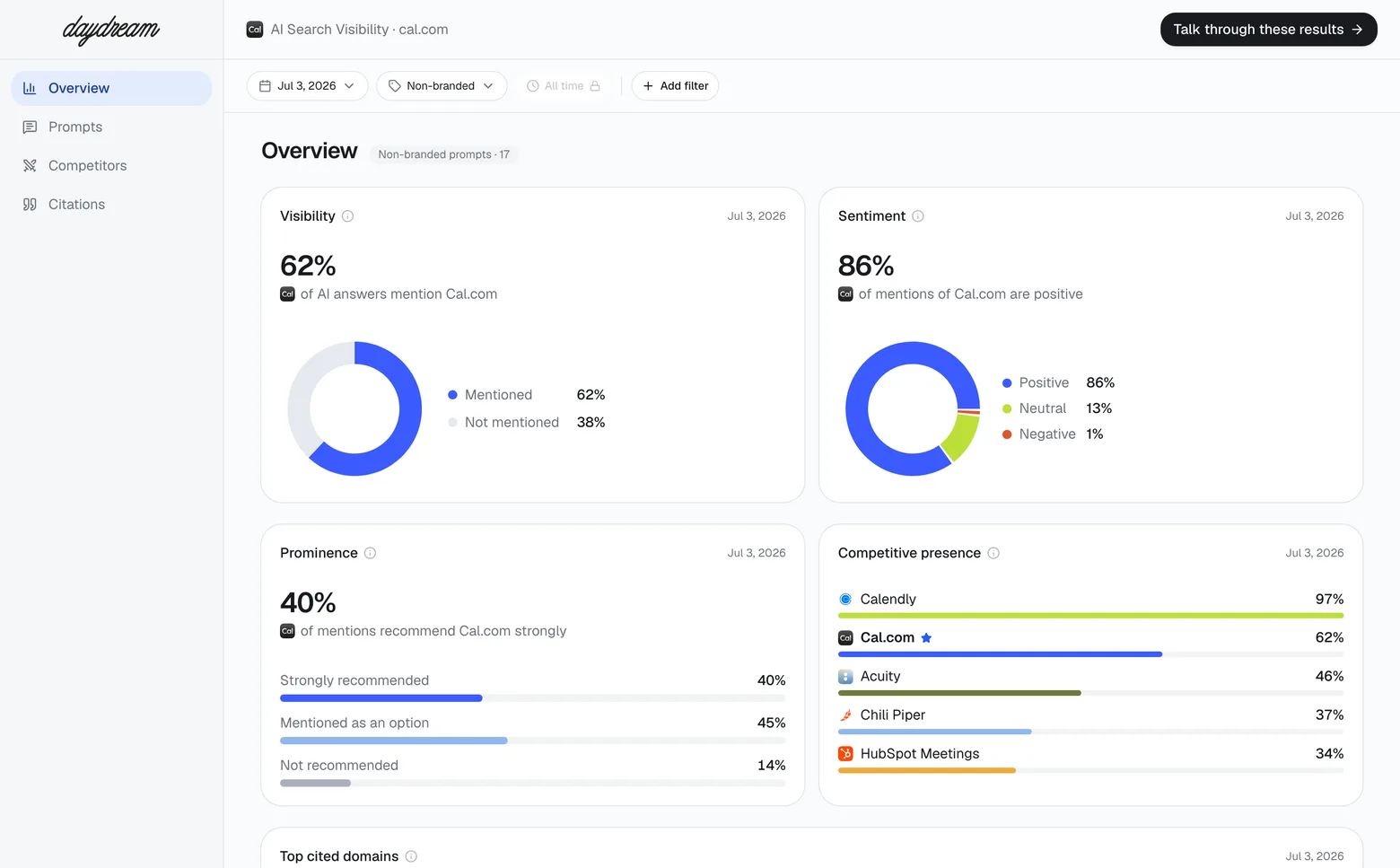
  1. AI Visibility (When: immediate, as part of content design)

Outcome: Presence in AI-driven answers, chat results, and snippet engines.

Why: By 2026, answers and AI assistants are primary entry points. We optimize for extractable answers: clear definitions, numbered steps, and structured FAQs that feed knowledge graphs and assistant responses.

Decision rule: If your user queries include "how," "best," or feature-explainers, structure content to be machine-consumable. Don't wing it, design content blocks for extraction.

  1. Performance Analytics (When: continuous)

Outcome: Attribution clarity and faster experiment learnings.

Why: Without tight measurement, content is guesswork. We instrument each asset to trace to trials, demos, or revenue. Use cohort analysis to find the content shapes that predict conversions.

Decision rule: If you can't tie content to pipeline in 90 days, stop producing long-form assets until measurement is fixed.

How we sequence these for clients

We don't sell a one-size playbook. We sequence based on two inputs: technical health and product motion. For a PLG SaaS with clean technical fundamentals, start with keyword strategy + AI visibility + programmatic pages. For an enterprise-focused product with technical debt, prioritize technical SEO, editorial targeted at buying committees, and authority building. In every case, performance analytics runs parallel. On a closely related note, see our guide to B2B SEO case study.

A practical 90-day example

Month 1: Technical crawl fixes, priority keyword mapping, and a test editorial asset optimized for AI extraction.

Month 2: Launch 10 programmatic pages tied to high-intent feature queries and run a targeted authority campaign for three cornerstone assets.

Month 3: Measure cohort performance, double down on formats that drive PQLs, and iterate with conversion optimization in product flows.

Where agencies fail and what we do differently

Most vendors either produce content or run link outreach. They rarely tie output to product events or own technical execution. We pair senior strategists with AI-enabled execution to compress timelines: first strategic deliverable in seven days, measurable experiments within 30–60 days, and a clear route from search visibility to pipeline. Our job is to make organic a predictable channel, not a black box.

Conclusion

Content of strategy is the discipline that turns content into recurring revenue. For B2B SaaS teams facing growth plateaus, the fastest improvements come from sequencing the seven levers against technical reality and product motion, measuring content by pipeline, and owning execution end-to-end. If you want faster signal and less guesswork, treat content as a systems problem, not a creative bucket. That shift is where predictable ARR growth starts. Pair this with our guide to B2B marketing content for a fuller view.

About the author(s)

Kim Huong Tran

Founding Marketer

Kim Huong Tran

Kim has been making complex ideas feel simple for over a decade. She has built content programs from the ground up at AI/ML companies, shipped global campaigns, and written everything from customer stories to IPO communications. At daydream, she leads content and brand, working at the intersection of creativity and performance to shape how we show up. Outside of work, she creates content with her corgis.

Thenuka Karunaratne

Co-Founder & CEO

Thenuka Karunaratne

Thenuka started daydream to help high-growth companies turn organic search into a real growth channel. Before this, he founded Flixed, which drove over 100,000 subscribers to streaming services through programmatic SEO. He also serves as an SEO Expert in Residence for several venture capital firms, advising portfolio companies on organic growth. His interests range from Zen Buddhism to learning Mandarin Chinese, and he hosted a podcast called "Wandering with Thenuka."

daydream team

daydream team

The daydream team shares industry insights, expert strategies, and customer success stories to help brands understand the moments that matter most in search.

SEO is hard to win

daydream delivers an unfair advantage in organic search by combining a proven methodology with SEO agents and dedicated experts.

Get started on Full-Service