“Really strategic partner where we could brainstorm and come up with compelling ideas.”
- Company
- “Wealthfront for startups.” Software for employees at venture-backed companies managing private equity and stock options.
- Industry
- software for private equity and stock options
- Engagement
- Organic SEO
- Timeframe
- 8 months
What you’ll learn
- How to turn proprietary data into a programmatic SEO moat
- How to scale content production without sacrificing accuracy
- Why an editorial foundation must come before programmatic scale
- Why building for Google and AI answers at once compounds
The challenge: linear content with no way to scale
Prospect is “Wealthfront for startups.” They build software tools to help employees at venture-backed companies manage private equity, minimize tax burden, and make informed decisions about stock options and tender offers. Founded in mid-2024, Prospect had some content marketing efforts (blog posts, Twitter, LinkedIn) but no SEO strategy.
Startup employees were already Googling equity questions. They were asking ChatGPT about ISOs vs NSOs. They were searching for company valuations to understand what their stock might be worth. Prospect had unique data that made them ideal for answering these questions, but they weren’t showing up in search results.
The content marketing they were doing produced linear returns. Post an article, get some views, watch traffic die down. There was no scalability and no sustainable growth. Prospect needed to reach more people in their ideal customer profile: middle-funnel prospects who were reasonably qualified and facing core challenges like exercising options or selling equity.
The constraint was resources. Prospect couldn’t churn out high volumes of content internally. They had no way to capture steady search traffic from people Googling specific questions. Competitors like Carta had some presence, but most players in the space hadn’t invested heavily in SEO. The opportunity was clear, but Prospect needed a partner who could execute at scale.
The hesitation was real. Equity and taxes are high-stakes topics. If the content is inaccurate, users won’t trust the software. The bar for accuracy was higher than most businesses. And for an early-stage startup, SEO represented a big financial commitment with uncertain returns. But Prospect had unique data, and their customers were already searching for this information. SEO was a strategic foundation that would compound if they started early.
I was pretty skeptical at first. Take those numbers with a grain of salt, right? But I recognized we had unique data, and I knew customers were already searching for this stuff. It felt strategic and important despite being so early in the company’s life.
Billy Gallagher, Founder of Prospect
The hypothesis: turn Prospect’s valuation-data moat into a programmatic engine
Prospect had something their competitors didn’t: current valuation data for private companies where startup employees actually worked. Research revealed that thousands of people search for specific company stock valuations every month, and most players in the space had left that demand uncaptured. If Prospect could publish an accurate, well-structured page for every company its customers were searching, its data advantage would become a search moat.
That was the bet. Programmatic SEO, built on data no one else had, could capture high-intent searchers at a scale no internal content team could match. The pages would answer decision-stage questions like “What is my Anthropic stock worth?” for people evaluating options, tender offers, and total compensation, exactly the users Prospect’s software was built for.
The solution: partner with daydream to build high-performing content at scale
Prospect received a diagnostic presentation outlining the opportunity: here’s what you’re doing, here’s the gap in search, and here’s what daydream can do. Working with daydream, Prospect followed a proven method built around sequencing the right investments at the right time. The sequence matters because each phase builds on the previous one. Keyword research feeds editorial strategy, editorial content reveals patterns that enable programmatic scale, and the entire foundation positions content for AI visibility.
1. Build the keyword strategy around Prospect’s data moat
Research revealed that thousands of people search for specific company stock valuations every month. “Anthropic stock” receives hundreds of monthly searches. “SpaceX stock” gets thousands. Dozens of other fast-growing startups had steady search volume with minimal competition.
These weren’t just high-volume keywords. They were decision-stage queries. When someone searches “What is my Anthropic stock worth?”, they’re evaluating whether to exercise options, consider a tender offer, or understand their total compensation. These searches map directly to someone who needs Prospect’s tools right now.
daydream also identified supporting themes like “How startup equity works” and “What are ISOs vs NSOs?” These queries build topical authority for users earlier in their journey who aren’t ready to use Prospect’s software yet but are learning about equity compensation. The keyword strategy created two paths: capture high-intent users searching for specific valuations, and build authority around equity education to rank for adjacent topics.
2. Establish an editorial foundation at 50 pages per week
The first phase focused on company pages because they aligned with Prospect’s data advantage. Each article followed a clear structure: current valuation data, company background, growth trajectory, and how equity compensation works at that company. “What is my Anthropic stock worth?” included information on Anthropic’s latest funding round, valuation trends, and details about its equity packages. “What is my SpaceX stock worth?” did the same for SpaceX.
This structure was repeatable. Once daydream established the template, Prospect could produce 50 pages per week covering different companies. Each page targeted a specific company name plus “stock,” which meant minimal keyword overlap and clear search intent. Someone searching “Anthropic stock” wants information about Anthropic specifically, not a generic guide to startup equity.
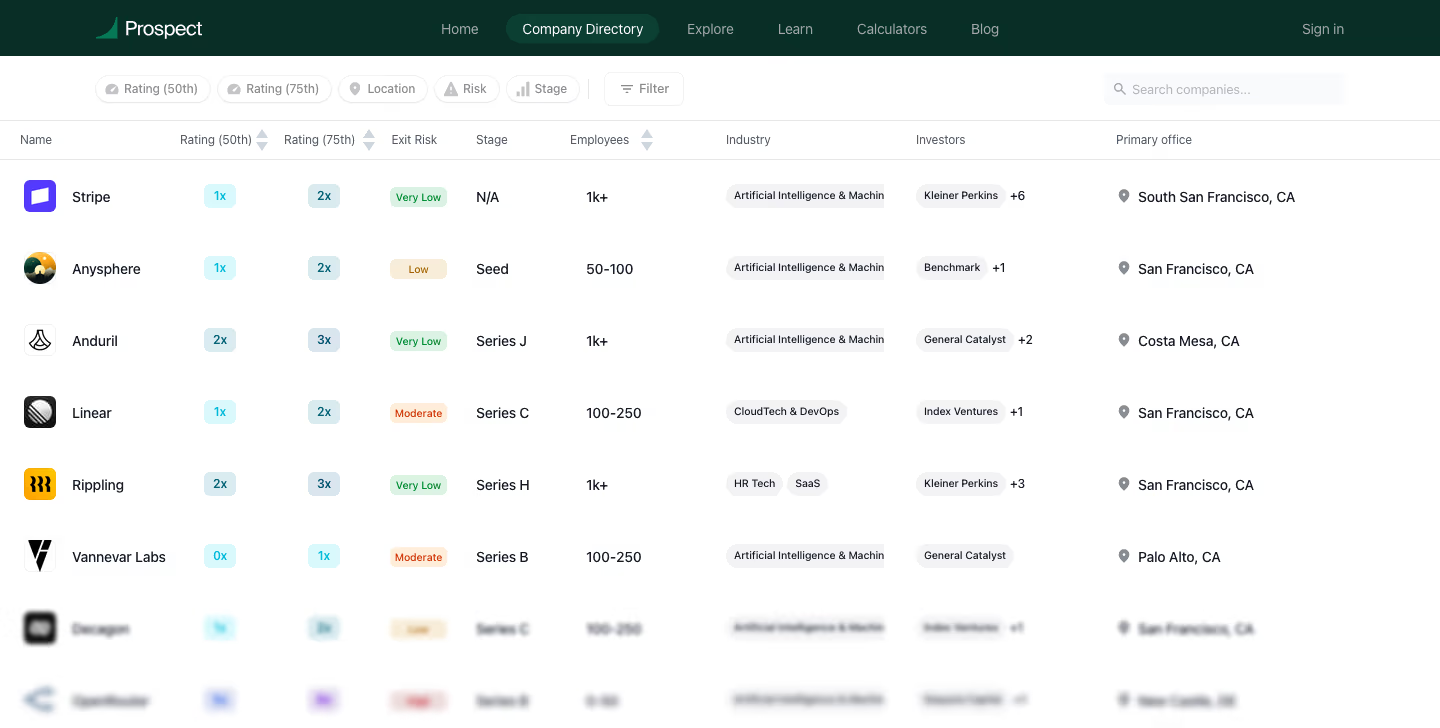
The challenge was scaling production 4x without quality degradation. Prospect worked with daydream over several weeks to refine the process. They started with small batches of 10-15 pages, tested different data sources, iterated on how to present valuation information clearly, and refined the structure based on what ranked fastest. Prospect’s quality review process evolved to combine an SEO agent for content validation with API calls to pull current company data automatically, rather than manual research for each page.
Very hands-on in a good way. It felt much more like part of the team you could rely on, versus a contractor you had to constantly follow up and bug.
Billy Gallagher, Founder of Prospect
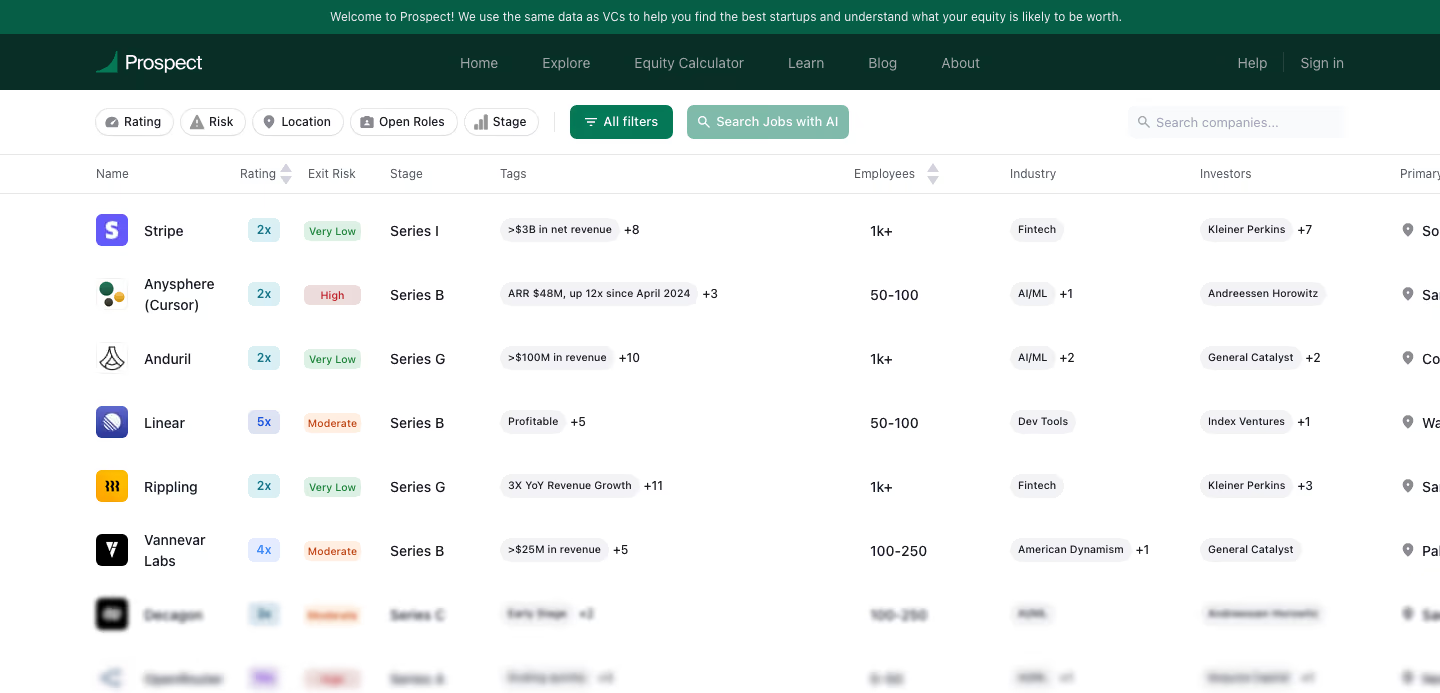
3. Scale programmatically to 200 pages per week
Once the editorial foundation was solid, Prospect needed to scale velocity without sacrificing quality. Working with daydream, they turned those 50 high-performing pages into a system. An SEO agent analyzed what made them rank and extracted the content patterns: pages that led with valuation data ranked faster than pages that buried it. Pages with 2,000-2,500 words performed better than shorter or longer articles. Pages with clear H2 headers for “Current Valuation,” “Company Background,” and “Equity Compensation” matched Google’s expectations for these queries.
Those patterns became templates that held at scale. What would normally require a 10-person content team (researching companies, gathering valuation data, writing explanations, and consistently formatting) became a system that produced 200 pages per week. Each programmatic page was held to the same standard: would a user searching for this find it helpful? Pages that didn’t meet that bar were iterated or pruned.
Midway through the engagement, Prospect and daydream conducted a strategy call to tear down their own pages. They analyzed what ranked on page one versus what didn’t. They found that pages with more specific equity details (option strike prices, vesting schedules, tender offer history) ranked higher than generic overviews. This insight led to a second step change: the team added more granular data to the templates. The upward curve got steeper.
Especially for resource-constrained teams like most startups, being able to lean heavily on daydream was huge. From executing the strategy of 200 pages a week to weekly updates, things kept moving even when we got slammed.
Billy Gallagher, Founder of Prospect
4. Optimize for Google and AI search at once
Prospect’s content needed to work in two places: traditional Google search and AI model responses. When someone asks ChatGPT “What is my Anthropic stock worth?”, Prospect wanted to be cited in the answer. The same applied to Perplexity, Gemini, and other AI search tools that startup employees were increasingly using.
The dual optimization meant structuring content so both systems could parse it easily. For Google, this meant clear H2 headers, semantic keyword usage, and structured data markup. For AI models, this meant placing direct answers at the top of the content (the first 200 words), formatting data into easy-to-extract blocks, and citing authoritative sources such as funding announcements and SEC filings that LLMs recognize as credible.
The strategy worked. Within months, Prospect started appearing in ChatGPT, Perplexity, and Gemini responses when people asked about startup equity. For a company founded in mid-2024, this validated that the content foundation was built correctly from the start, optimized for where search was going.
The results: 9x organic clicks and visibility across AI search
daydream set expectations upfront: June through August 2025 would be flat, and the curve would start taking off in October. That’s what happened. The growth was exponential once the foundation compounded.
The content engine (the “What is my [company] stock worth?” pages), from its launch in August 2025 to February 2026, grew to 4,406 monthly organic clicks and 1.9 million monthly impressions, across more than 1,290 ranking pages. It ranked on page one for hundreds of high-intent stock keywords, including #1 positions for Anthropic, SpaceX, and OpenAI stock queries.
Across the whole domain over the same window, growth compounded on every axis:
| Full domain | June 2025 | February 2026 |
|---|---|---|
| Monthly organic clicks | 566 | 4,991 |
| Domain rating | 18 | 26 |
| Referring domains | 83 | 230 |
On AI surfaces (per Ahrefs’ third-party index), by February 2026 Prospect’s pages were cited 26 times across ChatGPT, 41 times in Perplexity, and 91 times in Gemini.
During the engagement, Prospect earned top positions for the searches their customers cared about, ranking #1 for queries like “Anthropic stock,” “SpaceX stock,” and “OpenAI stock.” Those queries are searched every week, and Prospect captured that volume consistently.
The rankings created unexpected opportunities. Companies started reaching out after seeing their stock profiles rank on page one. They offered insider data, such as more current stock prices. It was validation that Prospect was building the domain authority and search presence they were aiming for across startup equity. By the end of the engagement, Prospect was publishing 200 pages per week, and the engine ran whether the team was focused on other priorities or not.
Prospect has since joined Crosby, where founder Billy Gallagher now leads marketing.
Really strategic partner where we could brainstorm and come up with compelling ideas. You have a great combination of competence and then just really friendly, awesome to work with.
Billy Gallagher, Founder of Prospect