“daydream is a self-driving content engine. Four months in, we’re at 1.59 million impressions and appearing in AI Overviews for 170 keywords. Sales conversations got shorter, and prospects arrive already informed. If SEO is the gap you haven’t had time to fill, they fill it fast.”
- Company
- The fastest immigration solution for tech talent, helping founders and engineers secure O-1 visas and green cards.
- Industry
- immigration platform for tech talent
- Engagement
- AI Search
- Timeframe
- 4 months
- Site
- lighthousehq.com
Four months ago, Lighthouse was invisible in search. When prospects asked how an O-1 visa works, the team had to send them to competitor websites for answers. Four months later, Lighthouse ranks on page one, often in the top five, for many of its commercial target keywords, appears in Google AI Overviews for its core immigration topics, and has its own resource library for the sales team to lean on.
Here is how Lighthouse built a content engine without spending an hour of its team’s time.
What you’ll learn
- Why three internal attempts to build content stalled, and what unblocked it
- How a keyword strategy built on commercial intent (not search volume) set the roadmap
- How editorial and programmatic pages were sequenced to compound
- The four-month search and AI-visibility results, measured in Google Search Console and Ahrefs
The challenge: no time to build content, no visibility in search
Lighthouse is the fastest immigration solution for tech talent, helping founders and engineers secure O-1 visas and green cards. Two years in, they had built real traction through referrals. But they were invisible to anyone who searched an immigration question first. The content library was small and the search presence was near zero. When prospects asked basic questions on sales calls, Lighthouse pointed them to other law firms’ websites.
Three internal attempts to build content had stalled. Someone would draft a post, get pulled into client work, and it would go nowhere. Creating content was no one’s actual job, so it sat at the bottom of the list every time. The constraint was time, not willingness.
Immigration content also raised the stakes. Every piece has to be legally accurate, the guidance changes constantly, and a single error can cost trust immediately. Prospects were increasingly asking ChatGPT and Claude about O-1 eligibility, not only searching Google. If Lighthouse was not present in those AI answers, it was missing a growing slice of its audience.
Lighthouse needed a partner who could run the whole program independently, hold immigration content to a legal-accuracy bar, and build for traditional search and AI search at the same time.
We tried writing blog posts internally. The problem was that no one ever made time for it. It always fell off the priority list when people got busy. No one’s specific job was to create content. The result was a handful of blog posts, but no consistent engine.
Luke Eure, Head of Growth at Lighthouse
The solution: a self-driving content engine
Before daydream wrote a single word, Lighthouse had a full keyword plan with target metrics, prioritized articles, and a three-month publishing schedule. The strategy document included competitive Search Engine Results Page (SERP) analysis, traffic-potential modeling, keyword clusters, and a content calendar mapped to Lighthouse’s sales cycle. The roadmap did not ask Lighthouse to manage anything.
daydream’s method sequences the work: start with keyword strategy, build an editorial foundation that sets the quality bar for immigration content, then scale through programmatic systems. Each lever builds on the one before it.
Keyword strategy: commercial intent over search volume
The approach started with commercial intent rather than raw search volume. Lighthouse had been tracking which questions came up repeatedly in sales conversations, prospects asking about lawyer costs, visa timelines, and eligibility. That feedback became the foundation of the keyword strategy, so the content answered real questions from qualified buyers instead of high-volume generic queries.
Primary themes focused on bottom-of-funnel queries:
- “do I need an immigration lawyer?”
- “immigration lawyer cost”
- “business immigration law”
- “immigration attorney fees”
- “h1b attorney fee”
Supporting themes built topical authority in the work-visa space: EB-1, O-1A, O-1B, EB-2 National Interest Waiver (NIW), visa sponsorship, H-1B extension, and labor certification (Form I-9, Form G-28, Form I-140).
Within a week, Lighthouse had a complete roadmap showing which keywords to target and why. daydream’s SEO agent analyzed the top 10 ranking pages for each target keyword, extracted content structures, identified SERP patterns, and built keyword clusters based on SERP overlap. It also pulled People Also Ask (PAA) questions to fold into the article FAQs. Done by hand, this research typically takes 40 to 60 hours.
For the primary keyword “O-1A visa,” the PAA questions to answer included:
- “Who qualifies for an O-1 visa?”
- “Is an O-1 visa easy to get?”
- “How long can you stay in the US with an O-1 visa?”
- “Is an O-1 visa better than an H-1B?”
The “O-1A visa” cluster grouped related searches by SERP overlap: “visa o1a” (77.8%), “o1a criteria” (66.7%), “o1a visa requirements” (60%), “what is o1a visa?” (60%), “o1a requirements” (50%). The clustering aligns the content with how Google groups related queries, which supports long-term ranking stability.
Editorial SEO: building the foundation
One of the first articles was “EB-1 Visa: Everything You Need to Know.” Its ranking climbed steadily, from position 24 in month one to roughly position 8 by month four. Today the page ranks on page one for its target terms, and Ahrefs shows Lighthouse at position 1 for “eb 1 visa” and “eb1 green card.”
Within the first month, Lighthouse had content live for EB-2 NIW, EB-2, O-1A, H-1B, and EB-1. Each article was structured around a primary keyword with three to five secondary keywords woven into the H2 and H3 headers, with internal links connecting related topics to distribute page authority.
Another strong performer was “How Long Does It Take to Get a Work Permit?” It climbed into the top of page one for its target query over its first several weeks and now sits at roughly position 2 to 3 in Google Search Console, appearing in multiple PAA boxes, including “How long does it take for an immigrant to get a work permit in the USA?” and “How long is an Employment Authorization Document (EAD) taking these days?”
Programmatic SEO: location-based lawyer pages
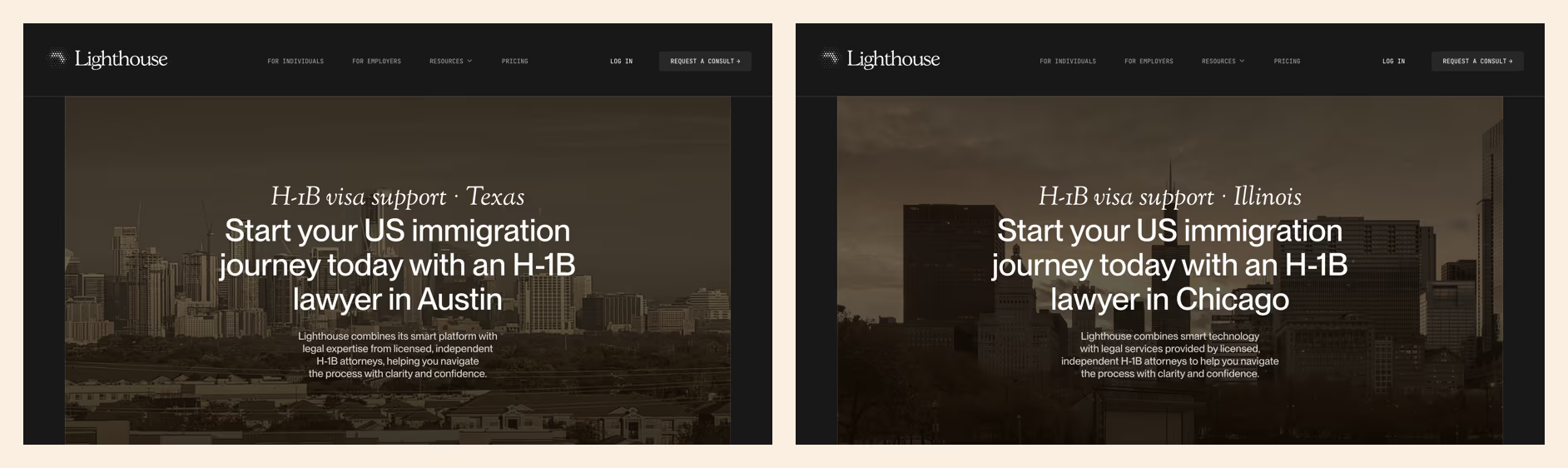
Alongside the editorial work, daydream deployed a set of programmatic pages targeting “H-1B Lawyer in [Location]” variations, with locations identified from Ahrefs data and Google Trends. This set is smaller than a typical programmatic build, but the bottom-of-funnel intent converts at a high rate: Lighthouse reports a visitor-to-demo booking rate of roughly 17% on these pages. Example pages include lighthousehq.com/h-1b-lawyer/austin and lighthousehq.com/h-1b-lawyer/chicago.
Dual optimization: built for traditional and AI search
Every article was optimized for Google rankings and AI search at once. For Google: semantic keyword clustering, structured data, and PAA optimization. For AI surfaces: a factual answer in the first 200 words and citations to U.S. Citizenship and Immigration Services (USCIS) guidance. Lighthouse’s legal team could review anything before it published, but they did not need to intervene. daydream’s content process cross-references official USCIS documentation, studies how immigration attorneys structure similar explanations, and formats each answer to match real search behavior.
The results: page-one rankings and AI visibility in four months
Lighthouse’s rankings improved steadily across their target keywords. In immigration search, governmental sites (USCIS, Department of State) hold positions 1 to 3 and cannot be outranked, so the goal was the top five, which Lighthouse reached for many of its primary targets.
In the first four months from the October 2025 launch, measured in Google Search Console:
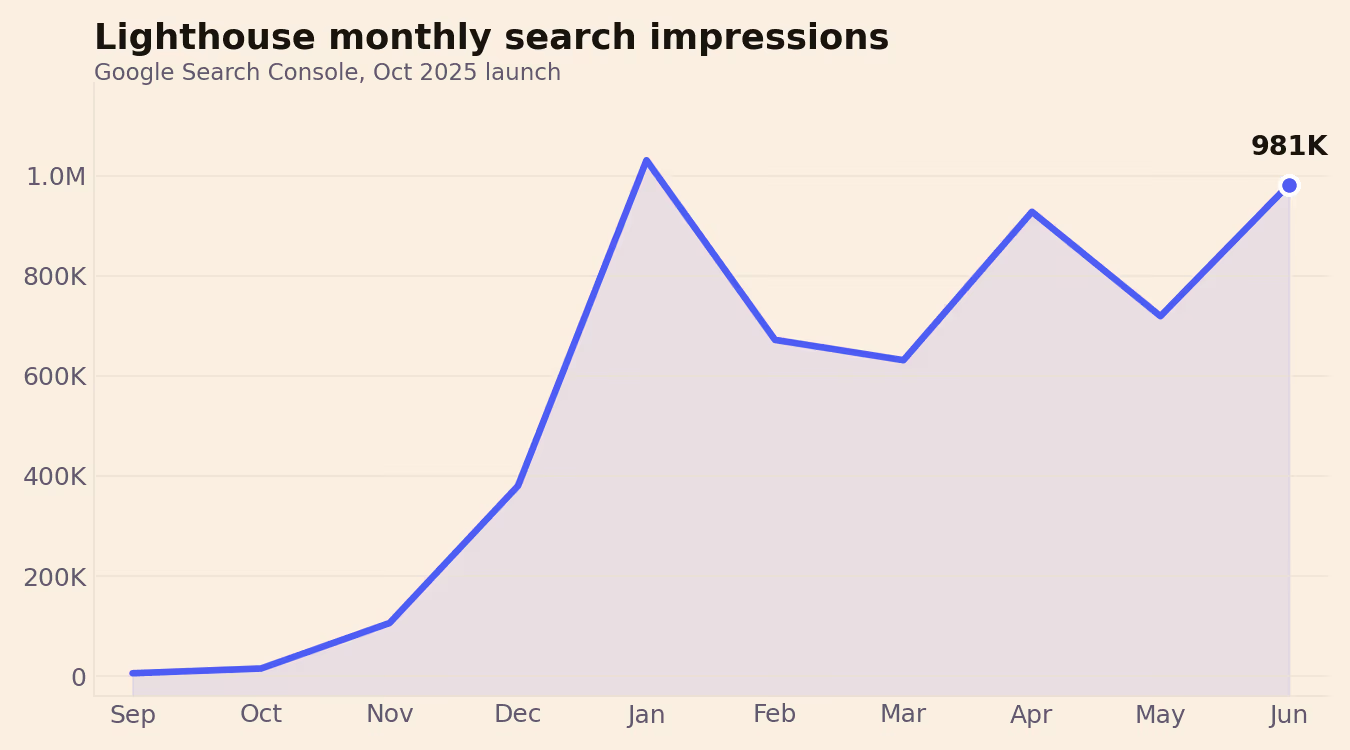
- 1.5 million impressions and more than 8,400 clicks across search
- 92 published pages (48 editorial articles and 44 programmatic pages)
- Impressions in the trailing four weeks roughly doubled versus the prior four weeks, to about 980,000
- Cited in Google AI Overviews across their core immigration topics, and ranking for a large and growing set of AI-Overview keywords (Ahrefs)
- Multiple articles ranking in PAA boxes
Ahrefs corroborates the search picture: Lighthouse now holds a position-1 ranking for high-volume, non-branded immigration terms including “visa sponsorship,” “eb1,” and “green card renewal online,” most of them carrying an AI Overview.
Lighthouse now sends prospects to its own content instead of competitor websites. Sales conversations are shorter because prospects arrive informed, having already read the answers that used to come up on discovery calls. The engine runs without pulling time from Lighthouse’s team. Four months in, Lighthouse has what it could not build internally: articles ranking on page one, AI search citing its expertise, and its own answers to the questions its buyers ask. For founders and engineers navigating one of the most stressful processes of their careers, Lighthouse can now be the place they find first.
daydream is an incredibly self-driving partner. They can do a lot with very little input. They create good articles, have an extremely solid strategy, and maintain very proactive communication. The rate at which they produce content and get it indexed is really impressive. If SEO is a gap you know you need to fill but haven’t made time for, daydream is a great partner.
Luke Eure, Head of Growth at Lighthouse