“I wasn’t sure organic search could produce pipeline for a product as specialized as ours. It ended up producing 39% of our site’s leads during our time with daydream.”
- Company
- A GTM tech company selling to B2B sales and marketing teams
- Engagement
- SEO and AI visibility
- Timeframe
- February 13 to August 1, 2026 (first pages live in March), with a data follow-up in October
What you’ll learn
- How we launched a programmatic section at scale, then cut it back to the pages that earned impressions
- How we templated commercial comparison content for buyers and AI assistants
- Why vertical landing pages drew only 3% of impressions but produced about half of the leads
- Where we directed links and how we verified every number before publishing
The challenge: limited search presence against much larger vendors
The client sells GTM software to B2B revenue teams, competing with the category’s largest vendors, which had years of search authority and buyer awareness.
The baseline showed the gap: the first new pages drew just 48 organic clicks in March, their launch month, and the domain had a Domain Rating of 16. The domain also appeared in about 0.1% of tracked AI answers to vendor recommendation queries in its category. With little search visibility and no proof organic traffic could generate pipeline for such a specialized product, the team needed a focused way to compete.
The hypothesis: a narrower version of the category leader’s programmatic playbook
The category leader drew much of its search traffic from programmatic pages. Rather than match that footprint outright, we planned a narrower version around the client’s strongest opportunities. Once those pages expanded reach, we would add commercial comparison content for buyers evaluating vendors and vertical landing pages designed to turn that attention into leads.
The solution: four steps over six months
1. Launch programmatic reach pages, then retain those that Google rewarded
First, we tested reach at scale: in March and April, about 19,500 programmatic pages went live. Each was roughly 470 words, with structured data, a full-sentence H1, and a canonical tag.
Scale alone wasn’t the goal, so early performance data decided what stayed. After three weeks, Google Search Console showed that most pages drew almost no impressions, so we removed and redirected them, concentrating the section on pages showing demand. By May 10, 5,942 pages remained, and 3,677 redirects sent visitors from removed URLs to pages still earning impressions.
2. Build commercial comparison content on a fixed template
Next, we turned to buyers closer to a decision. By late June, the commercial section contained more than 180 articles targeting high-intent searches from buyers comparing and shortlisting vendors, along with buyer’s guides for each product category.
A fixed template made that output consistent without reducing every article to the same argument. Each buyer’s guide ran 1,800 to 2,200 words across seven or eight H2 sections, each headed by a complete sentence stating the section’s main point. Comparison tables helped readers evaluate options, while an FAQ block answered four to seven common questions using FAQPage structured data.
The template also kept the comparisons balanced. Each page began with a fair description of the other vendor before explaining the core difference and mapping four to six buying scenarios in a table. Placement reflected the reader’s intent: the client appeared first in buyer’s guides, but second or third on alternatives pages, after the vendor that prompted the search.
3. Add vertical landing pages that convert
With reach and comparison layers in place, we added pages built to convert: 98 vertical landing pages, launched in June (73 on June 5, 25 on June 21). Each targeted a high-intent, audience-specific search and included practical proof: a product sample, key capabilities, use cases, FAQs, and links to related pages.
Their impact was outsized: they drew only 3% of the new pages’ June impressions but produced about half of the leads.
4. Direct links to commercial pages, structure pages for AI, and verify every number
We built 62 links, all to commercial articles and none to vertical pages: 23 in April, 23 in May, and 16 in June. This strengthened the pages that introduced buyers to the client, while the vertical pages focused on conversion.
Visibility also depended on making each page easy for readers and AI assistants to interpret. We placed direct answers near the top, wrote headings as complete statements, and added FAQ structured data. Quality control tightened as the program grew. In May, we audited 117 articles against 51 rules. For the June batch, we traced every number to its web source, correcting 67 figures and removing 103 that we could not verify.
The results: 40 leads in 30 days and a top-five spot in AI answers
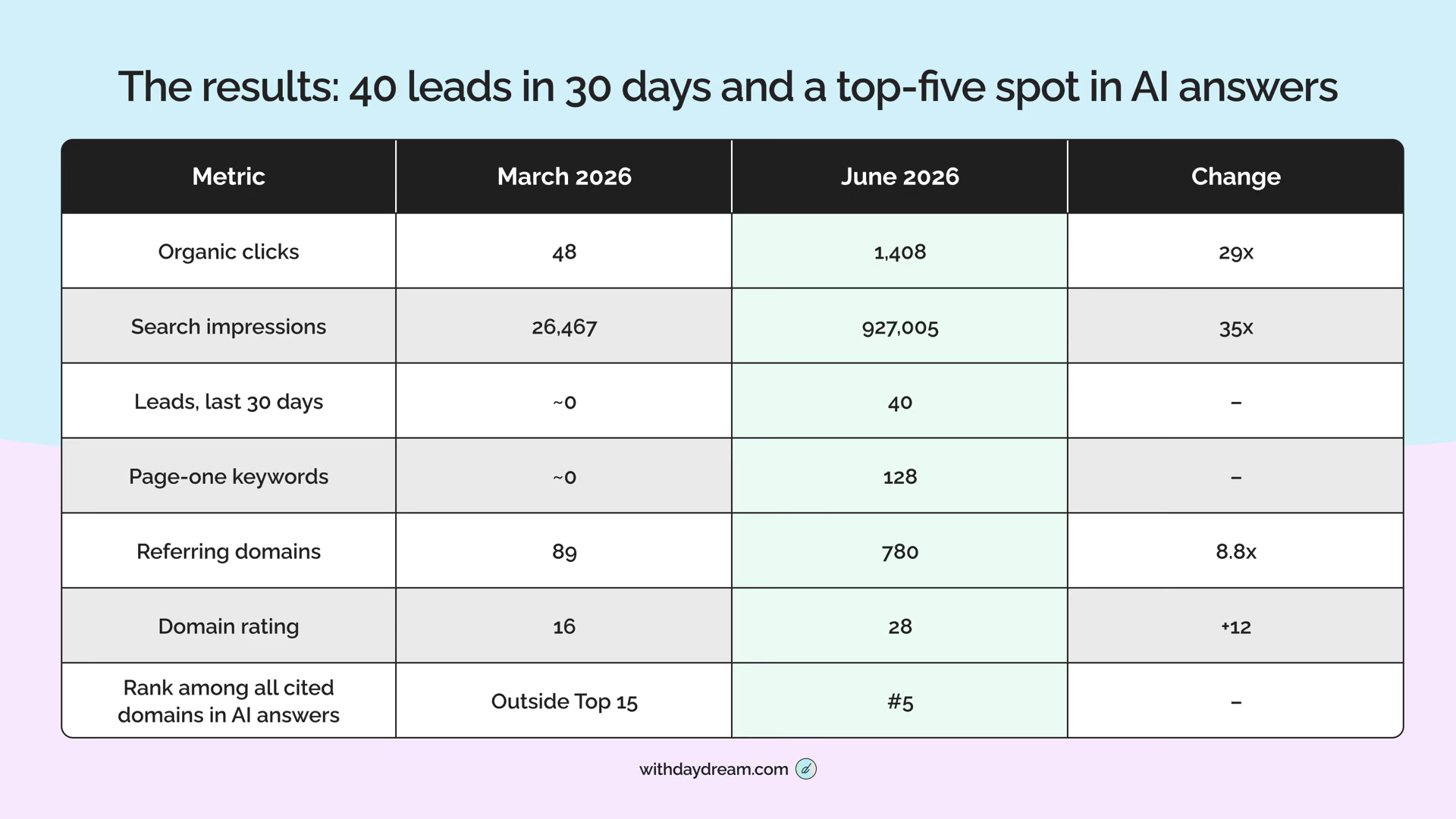
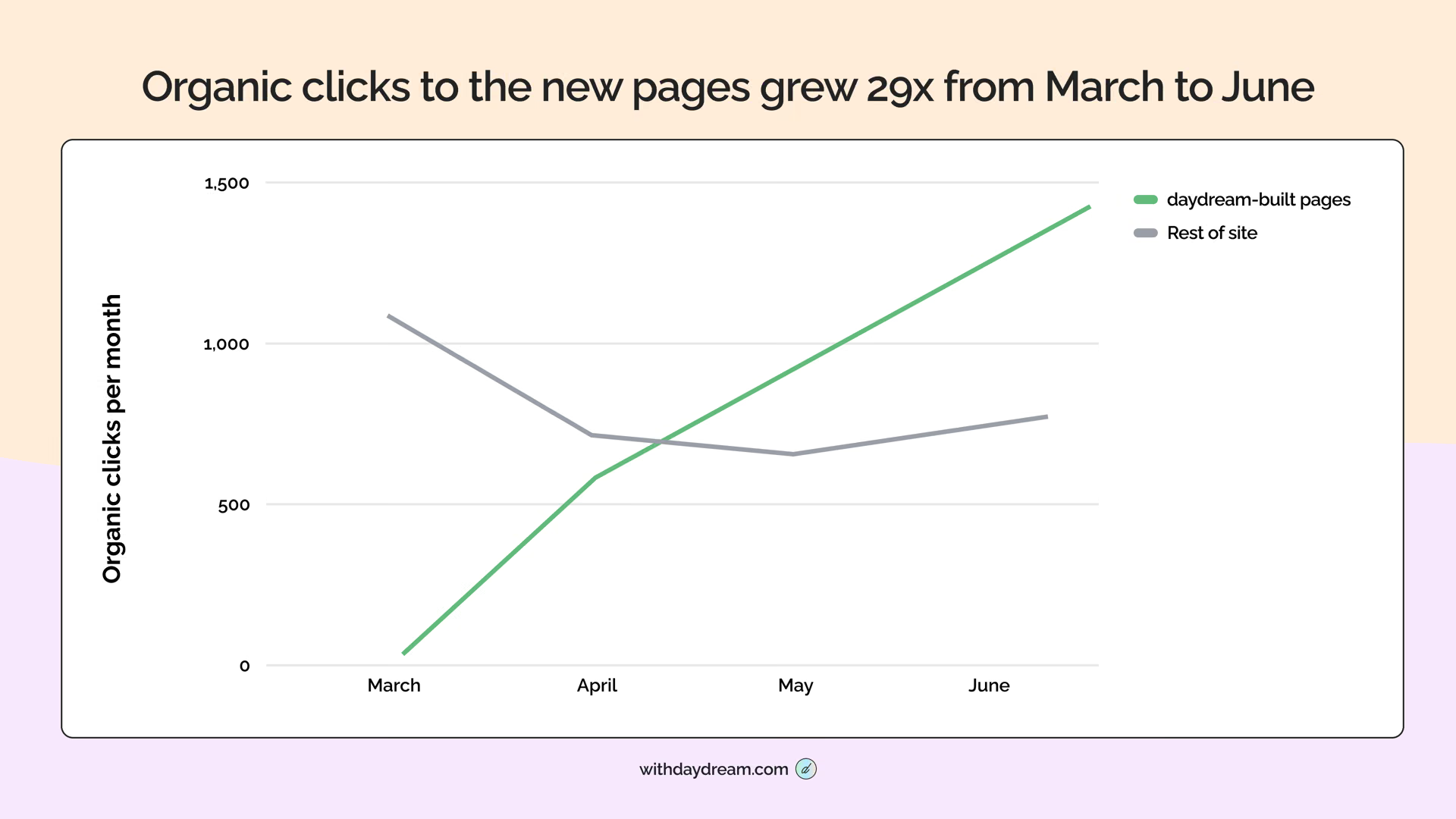
The new pages created the site’s growth: clicks to the rest of the site fell from 1,090 to 770 while the new pages grew 29x, so the gains did not come from broader site momentum.
Leads lagged, then accelerated: only five through May, then 40 in the 30 days ending June 21, for a total of 45 (37 from organic search).
I wasn’t sure organic search could produce pipeline for a product as specialized as ours. It ended up producing 39% of our site’s leads during our time with daydream.
Founder, GTM tech company
That acceleration also improved the economics: with most expenses in the earlier build months, cost per lead in the final 30 days was 81% lower than the six-month average.
Organic search became a major lead source: it generated 39% of all site leads, and the new pages accounted for 62% of the site’s organic clicks in June.
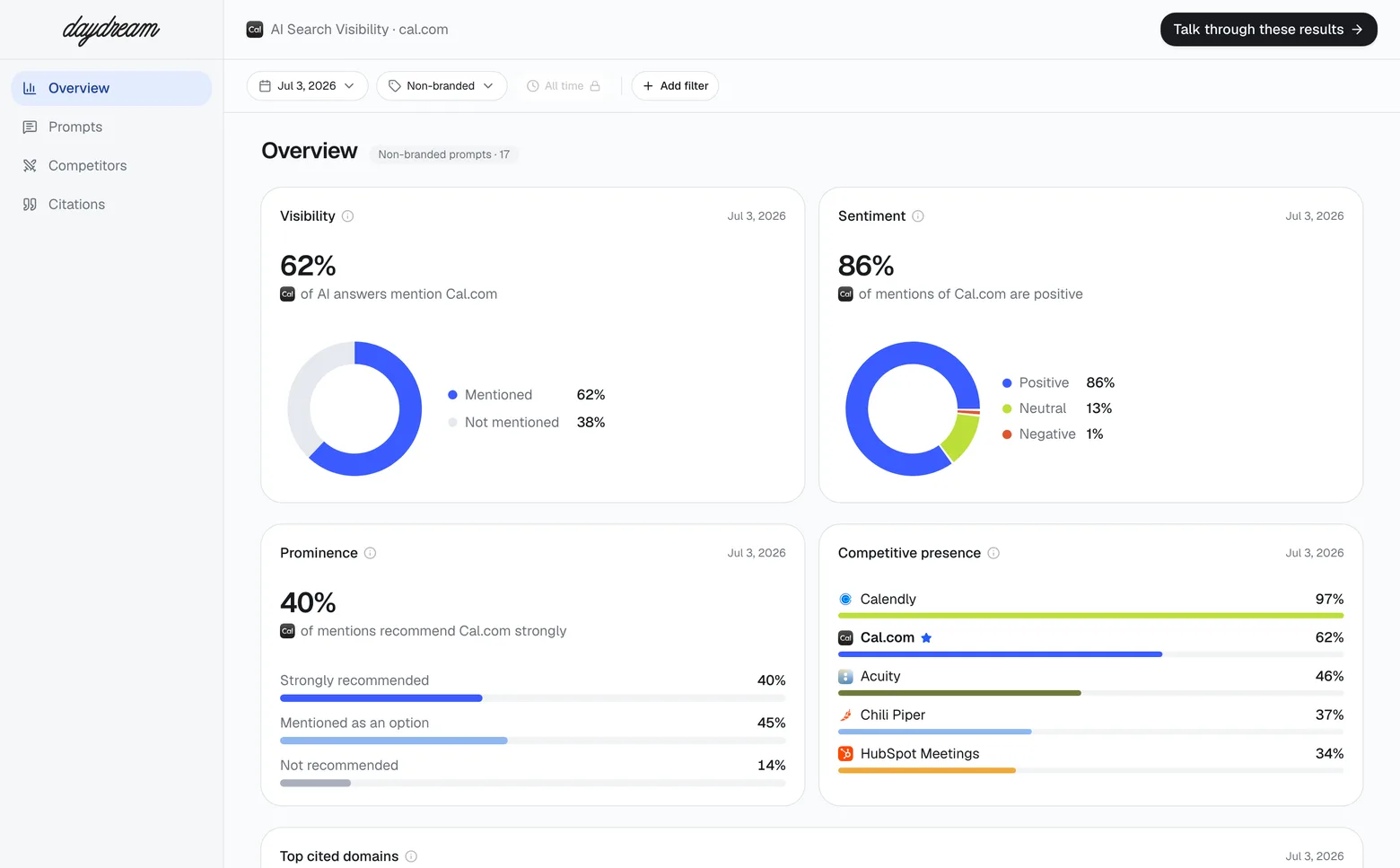
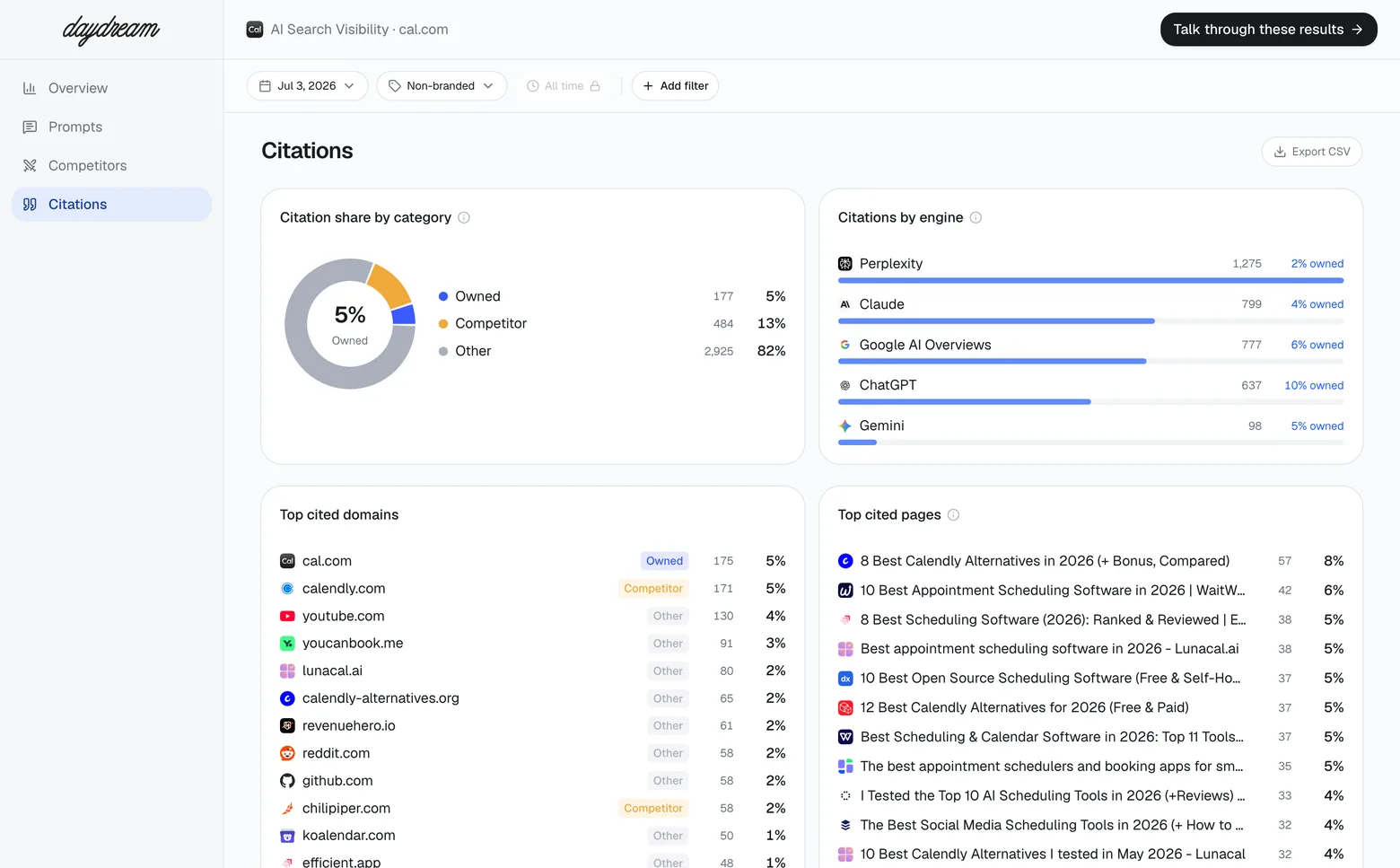
In AI answers, the client became far more visible: by June, its domain was the category’s fifth most-cited, ahead of several larger vendors. One buyer’s guide alone received nearly 600 citations.
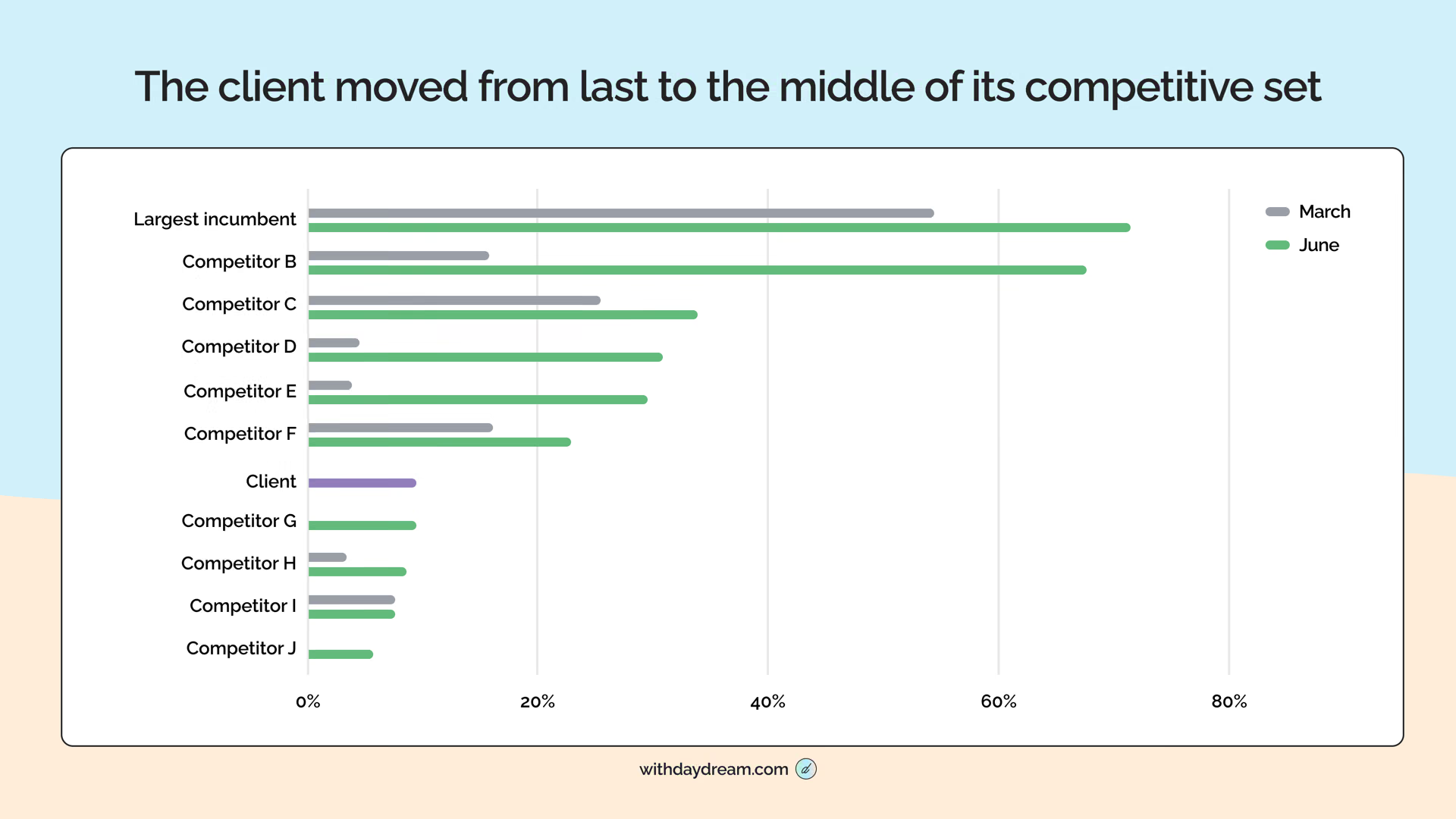
Share of AI answers rose too: across all tracked answers, the client’s share went from about 0.1% in March to roughly 10% in June, the middle of its competitive set. (March and June used different model versions, so the gain reflects both the content and the models.)
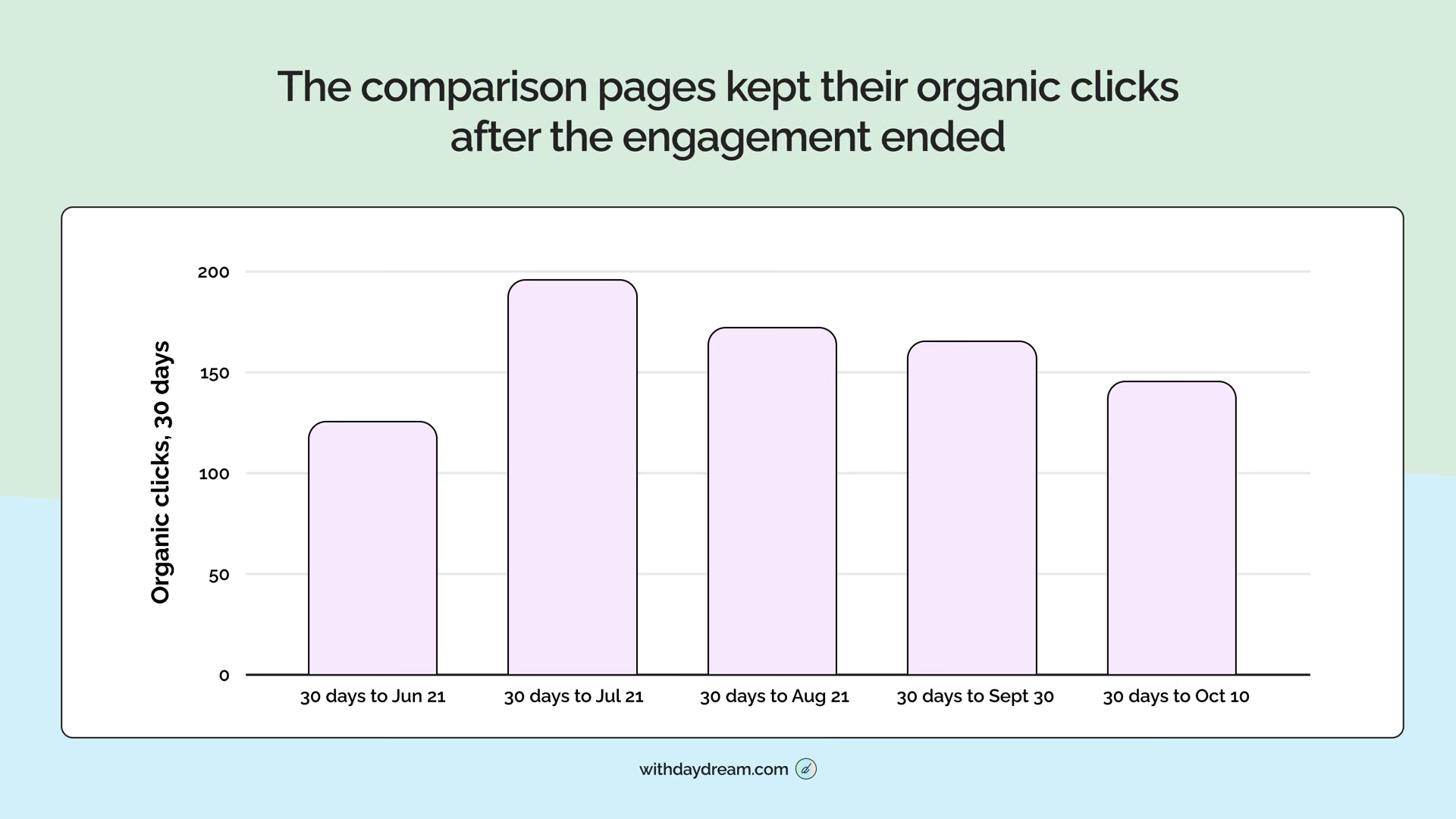
The results held after the engagement ended
The engagement ended on August 1, 2026, creating a useful test: would the gains persist without continued publishing? We checked again in October.
- The commercial comparison pages held their gains: after peaking in July, they drew 147 organic clicks in the 30 days ending October 10, still above the 126 in the 30 days ending June 21.
- AI visibility held: as of October 2026, the client remained the fifth most-cited domain in the category’s AI answers, and none of the 51 answers that mentioned the client were negative.
- Domain Rating kept rising: it reached 36, up from 28 in June.
We were up against the biggest companies in our industry with almost no presence in search or AI answers. Six months later, we were the fifth most-cited domain in our industry’s AI answers, and the gains held after we stopped publishing. I’d recommend daydream to anyone who needs SEO or better AI visibility.
Founder, GTM tech company
Book a call to see what this channel could do for you
If you run a B2B software company, the first question isn’t whether organic search and AI visibility can work in general, but whether they can create a defensible acquisition channel for your product and category. Book a 30-minute call with daydream, and we’ll review your competitive landscape, show where your product appears in AI answers today, and assess whether the opportunity justifies the investment.